Accounting Controls
Absorption costing of inventories, as required by US GAAP, has been criticized for encouraging managers to increase year-end inventories in order to boost reported profits. Which of the following techniques is the most effective at resolving this problem?
Answer:
Adoption of just-in-time (JIT) production systemAfter the Iraqi invasion of Kuwait in August 1990, the world price of crude oil doubled to more than $30 per barrel in anticipation of reduced supply. Immediately, the oil companies raised the retail price on refined oil products even though these products were produced from oil purchased at the earlier, lower prices. The media charged the oil companies with profiteering and price gouging, and politicians promised immediate investigations
Required: Critically evaluate the charge that the oil companies profited from the Iraqi invasion. What advice would you offer the oil companies?
Answer:
The opportunity cost of the oil in process was higher after the invasion and thus the oil companies were justified in raising prices as quickly as they did. For example, suppose the oil company had one barrel of oil purchased at $15. This barrel was refined and processed for another $5 of cost and then the refined products from the barrel sold for $21. Replacing that barrel requires the oil company to pay another $15 per barrel on top of the $15 per barrel it is already paying. Therefore, in order to replace the old barrel, the prices of the refined products must be raised as soon as the crude oil price rises.
However, accounting treats the realized holding gain on the old oil as an accounting profit, not as an opportunity cost. Therefore, the income statement of oil companies with large stocks of in-process crude will show accounting profits, unless they can somehow defer these profits.
Switching to income-decreasing accounting methods and writing off obsolete equipment will help the oil companies avoid the political embarrassment of reporting the holding gains. In January 1990, the large oil companies received significant adverse media publicity when they reported large increases in fourth-quarter profits.
It is useful having discussed this problem to ask the following question: What happens to oil companies in the reverse situation when a large, unexpected price drop occurs? Suppose the oil company purchased old barrels for $15 and sold the refined products for $21. New barrels now can be purchased for $10. The company would like to keep selling refined products at $21, but competition from other oil companies will push the price of refined products down. Depending on how quickly the price of refined products fall, the oil companies will report smaller (maybe even negative) accounting earnings as their inventory of $15 oil gets refined and sold, but at lower prices.The Alpha Division of the Carlson Company manufactures product X at a variable cost of $40 per unit. Alpha Division's fixed costs, which are sunk, are $20 per unit. The market price of X is $20 per unit. The market price of X is $70 per unit. Beta Division of Carlson Company uses product X to make Y. The variable costs to convert X to Y are $20 per unit and the fixed costs, which are sunk. Are $10 per unit. The product Y sells for $80 per unit.
Required:a. What transfer price of X causes divisional managers to make decentralized decisions that maximize Carlson Company's profit if each division is treated as a profit center?
Answer:
The transfer price should be equal to the opportunity cost of Alpha Division supplying X to the Beta Division, which is the market price of $70 per unit.
b. Given the transfer price from part (a), what should the manager of the Beta Division do?
Answer:
If the manager of the Beta Division must pay $70 per unit of X, the manager of Beta Division will not be able to generate a profit and should look for other opportunities rather than processing X
c. Suppose there is no market price for product X. What transfer price should be used for decentralized decision-making?
Answer:
If there is no market for X, the opportunity cost of supplying X is the variable cost of X or $40 per unit.
d. If there is no market for product X, is the operations of the Beta Division profitable?
Answer:
If the Beta Division only has to pay $40 per unit of X, then Beta can operate profitably by adding $20 in variable cost and selling product Y for $80 per unitThe Alphonse Company allocates fixed overhead costs by machine hours and variable overhead costs by direct labor hours. At the beginning of the year the company expects fixed overhead costs to be $600,000 and variable costs to be $800,000. The expected machine hours are 6,000 and the expected direct labor hours are 80,000. The actual fixed overhead costs are $700,000 and the actual variable overhead costs are $750,000. The actual machine hours during the year are 5,500 and the actual direct labor hours are 90,000.
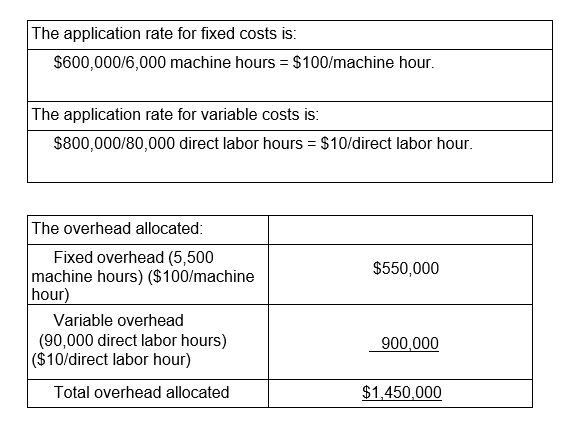
Required:a. How much overhead is allocated?
Answer
b. What is the over/under-absorbed overhead?
Answer:
There is no over/under-absorbed overhead: (700,000 + 750,000) – 1,450,000 = 0
5) At the Hilton Apple Fest and Trade Expo, James Jones, owner of Jones Orchard, saw a sign displayed in front of a vendor's booth: i can get you pesticides at $10.00 a gallon—guaranteed in writing! Over a one-year period, the vendor guarantees delivery of between 350,000 and 500,000 gallons of pesticide at a maximum price of $10 per gallon. Since Jones Orchard is currently paying $11.30 per gallon, the offer is appealing. However, Jones uses only 25,000 gallons and the annual management fee for this service is a whopping $275,000.
The only way Jones can see to make the offer work is to form a buying consortium with other farmers.
As long as all of the farmers are located within 10 square miles, the vendor is willing to allow the formation of a consortium. Including Jones Orchard, five farms are within this area.
Their pesticide needs and anticipated costs are as follows:
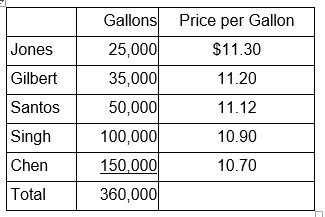
All of the farmers are willing to participate in the buying consortium as long as there is an anticipated cost savings for each farmer. Everyone agrees that each farmer should pay the same amount for materials. But allocation of the management fee is left entirely up to Jones.
Required:
a) Based upon the numbers provided, demonstrate that this consortium could work.
Answer:
For the consortium to be viable, it must meet the quantity and geography requirements of the vendor while reducing the pesticide costs to every member. The expected group demand of 360,000 gallons is within the stated requirements for purchase sand all members are within a 10-mile area, so the vendor's requirements are met.
Everyone can end up saving money if and only if the total costs expected for purchasing through the consortium are less than the total costs expected by purchasing outside of the consortium, suggesting the existence of potential savings to be shared by each member of the consortium.
The total expected outside costs are:
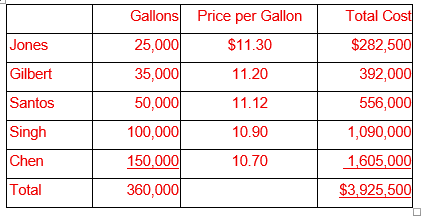
Within the consortium, the guaranteed maximum cost is the management fee plus the pesticide cost, $275,000 + 360,000 × $10.00 = $3,875,000. Therefore, costs are expected to be less within the consortium than outside it, providing an expected savings of $3,925,500 - $3,875,000 = $50,500.
Some may interpret the requirement that all members pay the same price for materials as implying that the maximum guaranteed price to be paid for materials within the consortium must be less than the cheapest outside price paid by any member. Since the $10 per gallon cost guaranteed to the consortium is less than Chen's $10.70 expected outside cost, this requirement would also be met.
b) Jones initially considers allocating the management fee either (1) equally between all members or (2) based upon each farmer's percentage of total gallons needed. Would either method work? Show allocation by each method.
Answer:
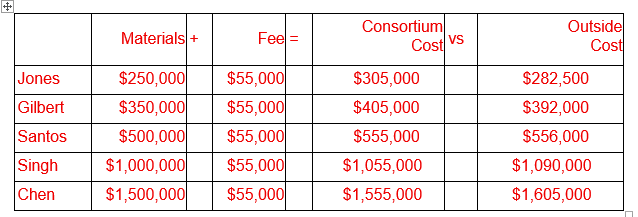
Neither method would work. Under equal allocation, Jones Orchard would pay $275,000 ÷ 5 + 25,000 × $10 = $305,000 within the consortium, versus $282,500 outside of it.
Since all members of the consortium have agreed to pay the same for materials purchased through the consortium, allocating by percentage would serve to provide all members with identical average costs per gallon. Under this allocation scheme, the average cost per gallon for the consortium would be (360,000 × $10.00 + $275,000) ÷ 360,000 = $10.764. Since this is greater than Chen's outside cost of $10.70 per gallon, this cost allocation scheme would also fail. The complete set of allocations follows:
Equal Allocation
Under equal allocation, each member would be allocated $275,000 ÷ 5 = $55,000 of the management fee. At a maximum cost of $10 per gallon for materials, Jones and Gilbert would pay more within the consortium than outside it.